




Quick Overview
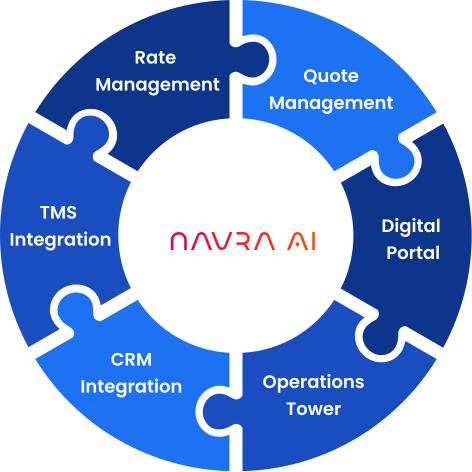
AI for freight forwarders can help turn rate files, customer enquiries and shipment information into structured inputs and suggested actions. VelocityOS connects AI-assisted work with freight pricing, quoting and operations. Available capabilities depend on your deployment, connected systems and permissions, with review and approval requirements defined for each workflow.
Freight forwarding teams lose time when insights arrive late and work stays manual. Documents are unstructured. Updates live in emails and spreadsheets. Velocity adds AI into daily workflows so teams can quote faster, reduce exceptions, and scale execution.
Choose an AI workflow for your freight team
Start with a recurring task where the inputs, required output and person responsible are clear. Agree what AI may prepare, what it may change and which actions require approval.
| Workflow | Required inputs | AI assistance to evaluate | Human review | Measure of success |
|---|---|---|---|---|
| Rate-sheet processing | Supplier files, charge definitions and validity rules | Extract fields and suggest mappings into structured rate records | Check conditional charges, units, currencies and restrictions before publishing | Processing time and correction rate |
| Quote preparation | Shipment requirements, approved rates and pricing rules | Organize enquiry details and prepare a quote draft | Confirm scope, rate validity, margin and customer-facing terms | Preparation time and revision rate |
| Enquiry handling | Customer messages and required shipment fields | Identify the request type and highlight missing information | Resolve ambiguity and approve commercial commitments | First-response time and completeness of requests |
| Shipment exception review | Milestone events, source timestamps and operational notes | Summarize changes and suggest follow-up actions | Verify the event, assess the impact and assign responsibility | Time to review and resolve exceptions |
These are workflow evaluation areas. Confirm the supported inputs, actions and integrations for your VelocityOS setup before implementation.
Explore the workflow guides
Explore the workflow guides
Explore the workflow guides
Choose a workflow to review its required inputs, approval points and measures of success. Each guide explains what to evaluate before introducing AI into daily freight operations.
AI freight quoting
Review how customer enquiries, approved rates and pricing rules become a quote that a person checks before sending.
Explore AI freight quoting software and approval controls.
AI rate-sheet extraction
Evaluate extraction from spreadsheets and PDFs, including ambiguous conditions, confidence scores and reviewer corrections before rates are published.
Read the AI rate-sheet extraction guide.
AI freight email automation
Explore how incoming messages can be classified, matched to shipment records and routed to the responsible team, with customer responses reviewed before release.
Explore AI email automation for freight forwarders.
Agentic TMS controls
Compare agent-based workflows with rules-based automation. Define permitted actions, human approvals and what happens when information or connections fail.
Read about agentic TMS workflows and automation controls.
AI freight visibility
Distinguish confirmed shipment events from estimates and predictions. Review how to assess alerts, assign exception ownership and measure operational response.
Explore AI freight visibility and exception management.
Connect AI with approved freight data and actions
A useful AI workflow needs access to the right information and clearly defined permissions. Identify which system holds the authoritative customer, rate, quote and shipment records before connecting tools.
For each workflow, define:
- Which records it may read.
- Which fields or actions it may update.
- Which steps require approval.
- How actions and corrections are recorded.
- What happens when information is missing or systems disagree.
Available connectors, APIs and MCP-compatible tools depend on the implementation. Confirm access and supported actions for each connection.
See what Velocity can sync when planning the data flow.
Measure the result before expanding automation
Choose one workflow and record how it performs before introducing AI assistance. Compare similar tasks after implementation, including the time spent checking and correcting outputs.
| Workflow | Baseline to record | What to compare after implementation |
|---|---|---|
| Rate-sheet processing | Time from receiving a file to approved rate publication | Total processing time, corrections and unresolved fields |
| Quote preparation | Time from a complete request to an approved quote | Preparation time, revisions and pricing corrections |
| Enquiry handling | Time to first useful response and missing-information requests | Response time, request completeness and incorrect routing |
| Exception review | Time from receiving an update to assigning an action | Review time, unresolved cases and unnecessary escalations |
Record the sample size, date range and workflow conditions alongside the results. Include review effort when assessing time savings, and investigate errors before increasing the scope of automation.